HEPA and Activated-Carbon Cabin Filters: Which Test Reports Matter?
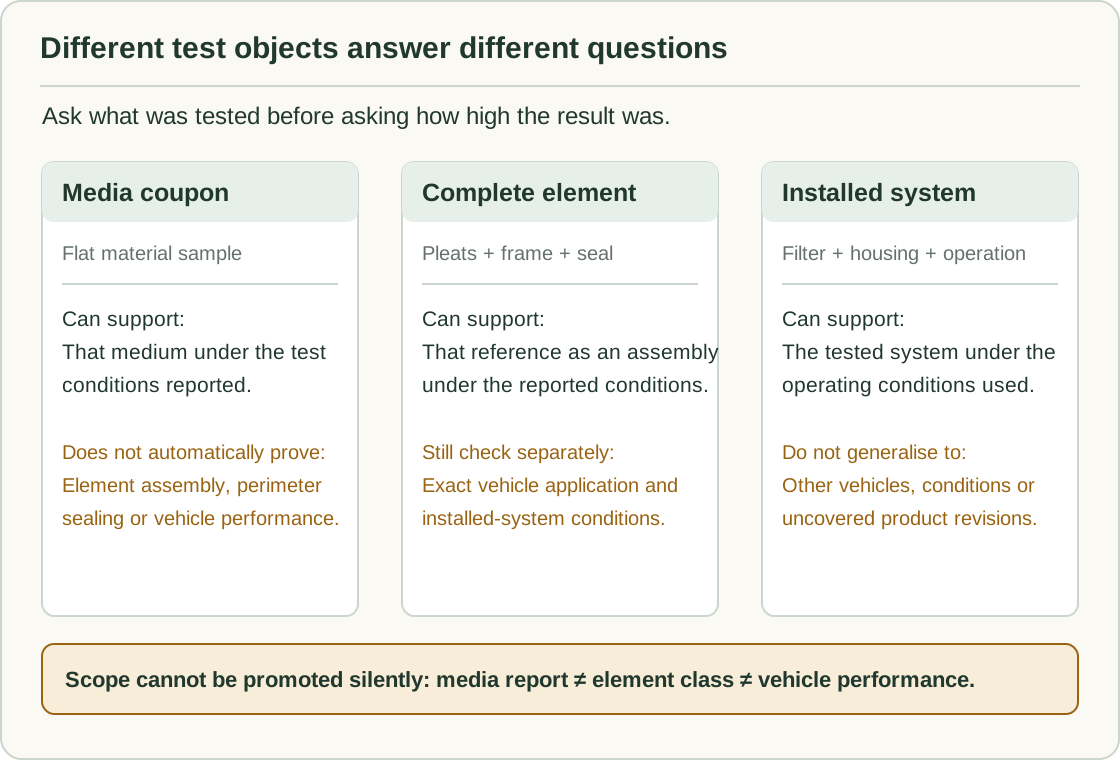
Start with the exact claim and the object that was tested. A media coupon report, a complete-filter test and a vehicle result answer different questions. None should silently stand in for the others when reviewing a HEPA or activated-carbon label.
1. Identify the claim, the sample and the report scope
Write the claim precisely before requesting documents: particle efficiency at a named size, a named HEPA class, a pressure-drop requirement, or removal of a specified gas. “Better air” and “high efficiency” are not complete acceptance criteria.
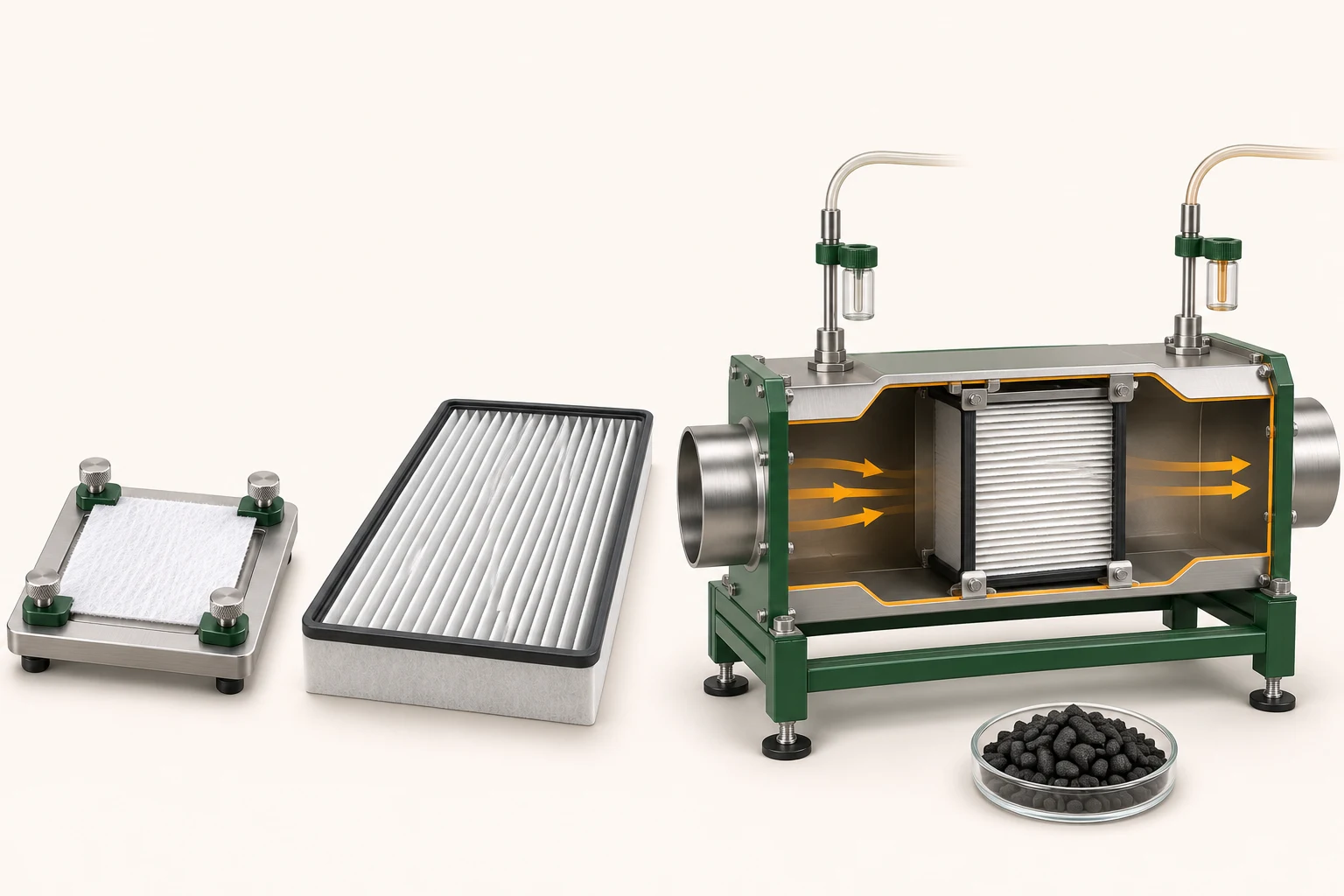
Then identify what was actually tested. A flat coupon supports conclusions about that material under its test conditions. A complete element includes pleats, frame and assembly. Installed-system results include the housing and operating conditions. Assembly leakage, geometry and system flow can change the question being answered.
References: ISO/TS 11155-1:2001: particulate filtration methods and scope, ISO 29463-1:2024: classification, performance, testing and marking, ISO 29463-5:2022: filter-element efficiency testing
2. For particle claims, request the size, flow and condition
ISO/TS 11155-1:2001 describes cabin-filter laboratory assessment of particulate filtration, including restriction, fractional efficiency and accelerated holding capacity. Its scope and controlled conditions matter; it is not a guarantee of the same ranking in every vehicle or service environment.
For a quoted percentage, retain the particle size or size range, method and edition, sample reference, airflow, conditioning and loading state. Ask whether the value is initial, after conditioning or after dust loading. Read the units and uncertainty information where reported. Do not turn one selected efficiency number into a claim across all particle sizes.
References: ISO/TS 11155-1:2001: particulate filtration methods and scope
3. A HEPA claim needs its named classification basis
Ask which classification standard, edition and class the label refers to. ISO 29463-1:2024 addresses classification, performance, testing and marking, while ISO 29463-5:2022 addresses filter-element efficiency testing at the most penetrating particle size (MPPS). EN 1822 is another named framework; do not silently mix class names or methods.
Check whether the evidence covers the complete claimed element, and whether overall efficiency and the applicable leak assessment are documented. A media-only test or a percentage without the classification basis does not establish the complete filter’s HEPA class. Nor does a class establish that the filter fits a particular vehicle or that the whole cabin achieves that filtration level.
References: ISO 29463-1:2024: classification, performance, testing and marking, ISO 29463-5:2022: filter-element efficiency testing, Camfil: EN 1822 and ISO 29463 HEPA factory tests
4. For activated carbon, ask which gas and for how long
An activated-carbon claim concerns adsorption of named gases under stated conditions. ISO 11155-2:2009 describes dynamic gas filtration testing for passenger-compartment filters. A particulate report does not substitute for this gas-removal evidence.
Request the challenge gas, inlet concentration, flow, temperature, relative humidity, test duration and defined breakthrough or removal endpoint. Read the result over time, not only an attractive initial value. A result for one gas cannot establish removal of every odour. Black colour or carbon mass alone is not a gas-performance test.
References: ISO 11155-2:2009: gaseous filtration methods
5. Review four different questions, not one marketing number
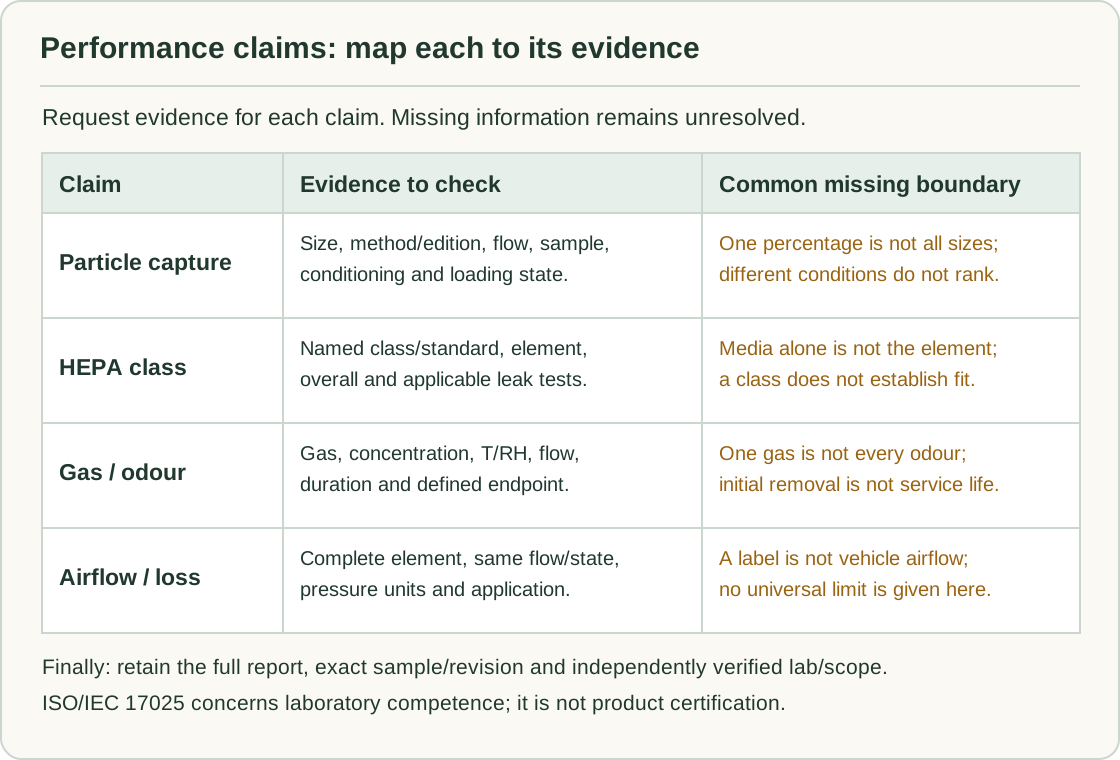
Use the matrix below to request the missing evidence. Keep the actual report number and sample reference beside each entry. This is a purchasing checklist, with no example performance values and no universal pass threshold.
| Claim or question | Evidence to request | Keep unknown when missing |
|---|---|---|
| Particle capture | Size-resolved result, method, flow, sample and conditioning/loading state | Efficiency outside the reported sizes or conditions. |
| HEPA class | Named classification, complete-element evidence and applicable leak assessment | A finished-element class inferred only from a media coupon. |
| Gas or odour removal | Named gas, concentration, environment, flow and time-dependent result/endpoint | Performance for untested gases or an unspecified service life. |
| Airflow compatibility | Complete-element pressure drop at a stated flow and loading state, plus application evidence | Vehicle airflow inferred from a label or a different-flow comparison. |
References: ISO/TS 11155-1:2001: particulate filtration methods and scope, ISO 11155-2:2009: gaseous filtration methods, ISO 29463-1:2024: classification, performance, testing and marking, ISO 29463-5:2022: filter-element efficiency testing
6. Check the report and the laboratory independently
Obtain the complete report, including identification pages, method, results and any qualifications. Match the sample model, material/construction revision, client and dates to the supplied product. A logo, an isolated screenshot or a laboratory name is not enough to establish that relationship.
Where accreditation is claimed, verify the laboratory and relevant scope through the accrediting body’s official directory. ISO/IEC 17025 concerns laboratory competence and consistent operation; it is not a product certificate for the filter. Use independently verified laboratory contact details to clarify a report, rather than relying only on a forwarded message.
If material, pleat construction, seal or production revision changes, ask whether the existing evidence still covers the supplied version and what reassessment is needed. A report date alone does not create a universal expiry period. Preserve disagreements and missing pages as open items.
References: ISO/IEC 17025:2017: competence of testing and calibration laboratories
7. Turn the review into a written purchasing decision
For each proposed claim, record the supporting report, exact supplied reference, agreed conditions and unresolved limitations. Ask the supplier to confirm any gap in writing. Decide separately whether the sample fits, whether the evidence supports the marketing wording, and whether the agreed specification is acceptable.
HDASHER’s diagrams here are editorial explanations. They are not our laboratory reports, accreditation or claims of a HEPA-certified product. For a specific supply project, agree the required tests and obtain the corresponding product-specific evidence before approving performance wording.
Build the testing requirements into an RFQ · Investigate weak airflow after replacement · Keep the review in procurement worksheets
Common questions
Does “99% efficiency” prove a HEPA cabin filter?
No. The particle size, method, class, sample scope and conditions are needed. A single percentage is not a complete-element classification or evidence of installed vehicle performance.
Can a material supplier’s report cover our finished filter?
It can support the identified material under the reported conditions. It does not automatically cover pleating, the frame, assembly leakage or the installed system. Request evidence appropriate to the finished product claim.
Does an ISO/IEC 17025 laboratory logo certify the product?
No. Verify the laboratory and the relevant scope, then read the specific report. Laboratory competence and the supplied filter’s performance are separate questions.
Sources & further reading
Check the current vehicle manual and the instructions supplied with the exact replacement filter. General guidance does not confirm a vehicle application.
- ISO/TS 11155-1:2001: particulate filtration methods and scope
- ISO 11155-2:2009: gaseous filtration methods
- ISO 29463-1:2024: classification, performance, testing and marking
- ISO 29463-5:2022: filter-element efficiency testing
- Camfil: EN 1822 and ISO 29463 HEPA factory tests
- ISO/IEC 17025:2017: competence of testing and calibration laboratories
For your next step
Comparing a specific filter? Keep the reference number, vehicle application and construction together when reviewing your options.