Cabin Filter Gaps or a Cover That Won’t Close: Fit Checks
A catalogue match is the starting point, not permission to force a filter into place. If the cover will not latch or the perimeter appears uneven, stop and check the exact application, the tray and the seal before using the vehicle normally.
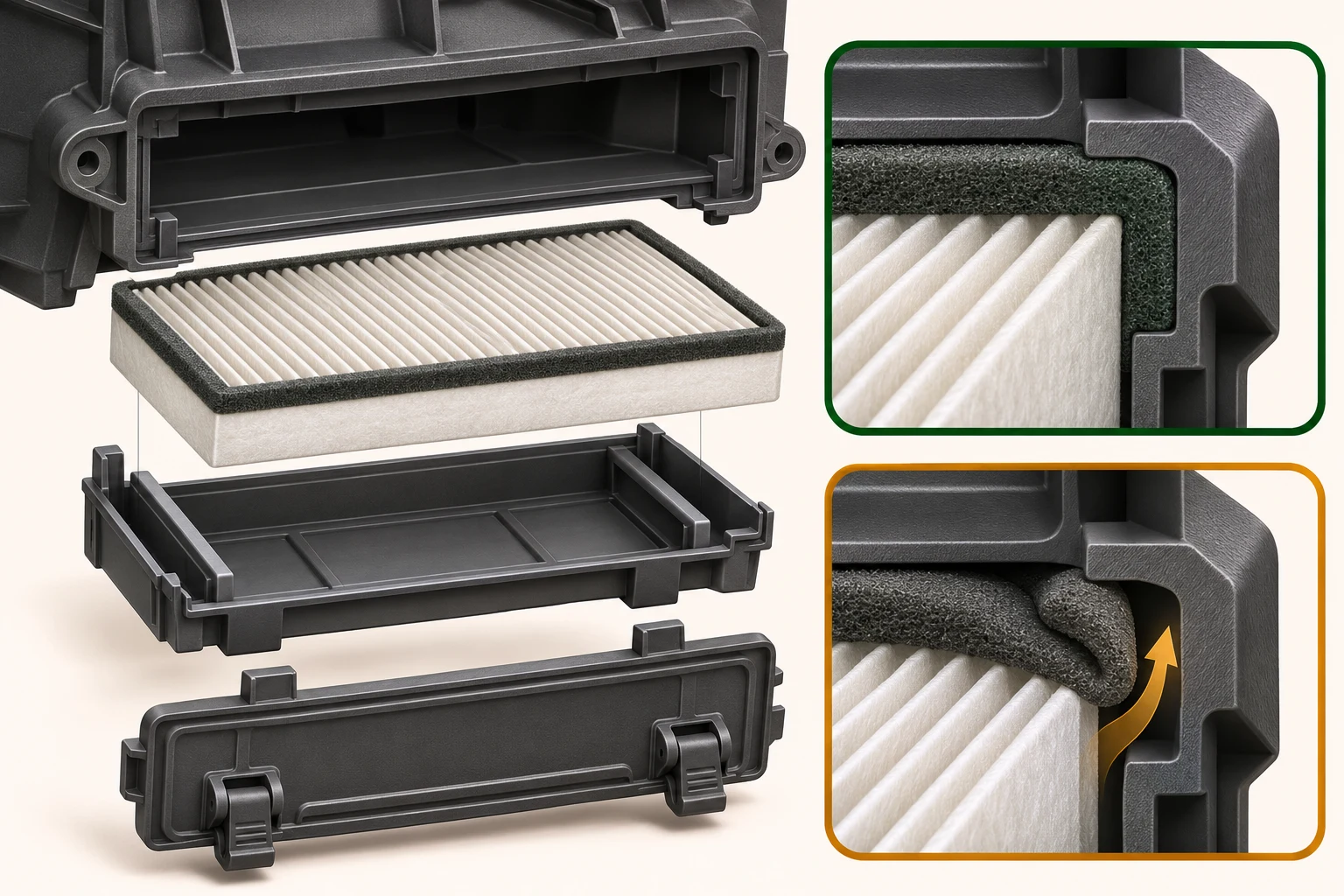
1. Stop before trimming, taping or forcing the cover
Switch off the vehicle and blower before opening the access area, and follow the vehicle’s installation procedure. Do not use extra force on a cover or moving HVAC door. A cover that closes only when forced is not a passed fit check.
Do not cut the rigid frame, remove a designed gasket, add improvised tape or pack the housing with extra foam to make an unconfirmed replacement fit. Those changes alter the assembly being evaluated. If the manufacturer specifies an adapter or a different tray, verify the exact instruction and part first.
Some filters are designed to flex during a specified installation procedure. Temporary, instructed flexing is different from permanent crushed pleats, a cracked frame or a rolled seal. Do not assume that every flexible filter is defective or that every filter may safely be bent.
References: DENSO: choosing and replacing a cabin air filter, DENSO: application and installation precautions (Japanese)
2. Recheck the reference and the complete application
Compare the reference on the actual element, its packaging and the supplier’s application record. Include any suffix or revision. Record the vehicle model, year range, sales market and relevant HVAC configuration. Confirm whether the replacement uses the original tray, a supplied tray or a specified adapter.
A previous filter is useful evidence, but not an unquestionable master: it may itself have been the wrong replacement. When the old part, catalogue and vehicle instructions disagree, ask for written application confirmation rather than choosing the one that appears easiest to install.
References: DENSO: choosing and replacing a cabin air filter, DENSO: application and installation precautions (Japanese)
3. Compare the geometry that actually locates the filter
Length, width and height are only part of the fit. Keep the rigid frame dimensions separate from free, uncompressed foam dimensions. State the measuring datum and method; compressing a soft seal with a calliper can create a misleading comparison.
Also record corner profiles, steps, tabs, rail positions, tray depth and whether the application uses a multi-piece set. A small difference at a locating feature can matter even when the headline dimensions are similar. This guide does not supply universal tolerances: use the approved drawing or application-specific requirement.
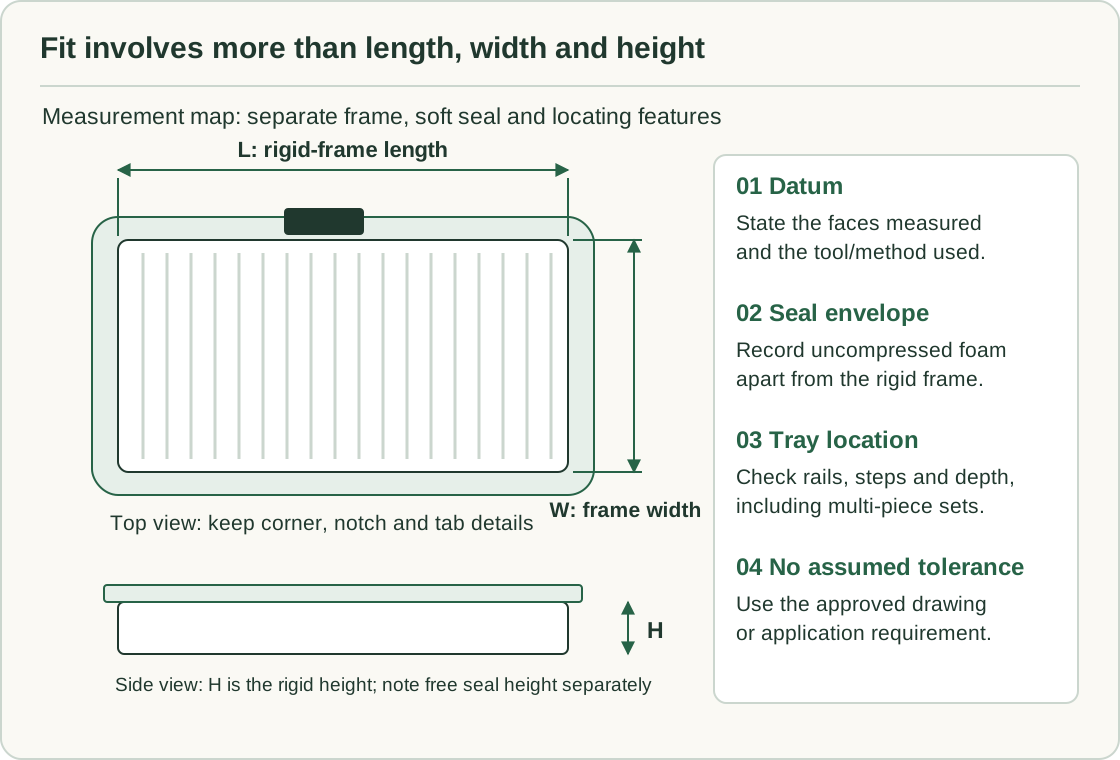
| Feature | Record separately | Reason to check |
|---|---|---|
| Rigid frame and total envelope | L × W × H; datum; method; uncompressed seal envelope | A soft seal and a hard frame should not share an undefined dimension. |
| Corners and locating details | Corner shape, notches, tabs and rail positions | Similar overall size does not ensure that the tray locates correctly. |
| Tray and cover | Tray reference, seating depth, lid tabs and latch engagement | An incorrect or displaced carrier can prevent closure. |
| Seal path and construction | Gasket continuity, joints and the contact plane | Air can bypass the media if the intended perimeter contact is interrupted. |
References: DENSO: application and installation precautions (Japanese), MANN-FILTER: quality comparison guide (PDF)
4. Separate an exterior gap from a filter-seal bypass
The visible cover joint is not always the filter’s sealing plane. A cosmetic gap at an outer panel and a discontinuity around the filter perimeter are different observations. Identify where the design is intended to seal before declaring that air is bypassing the filter.
With safe access, inspect for a folded or displaced gasket, a missing corner contact, debris on the seating face or an incorrectly positioned tray. Confirm the contact against the instructions or an approved sample. A photograph can document an irregularity; it cannot by itself quantify leakage.
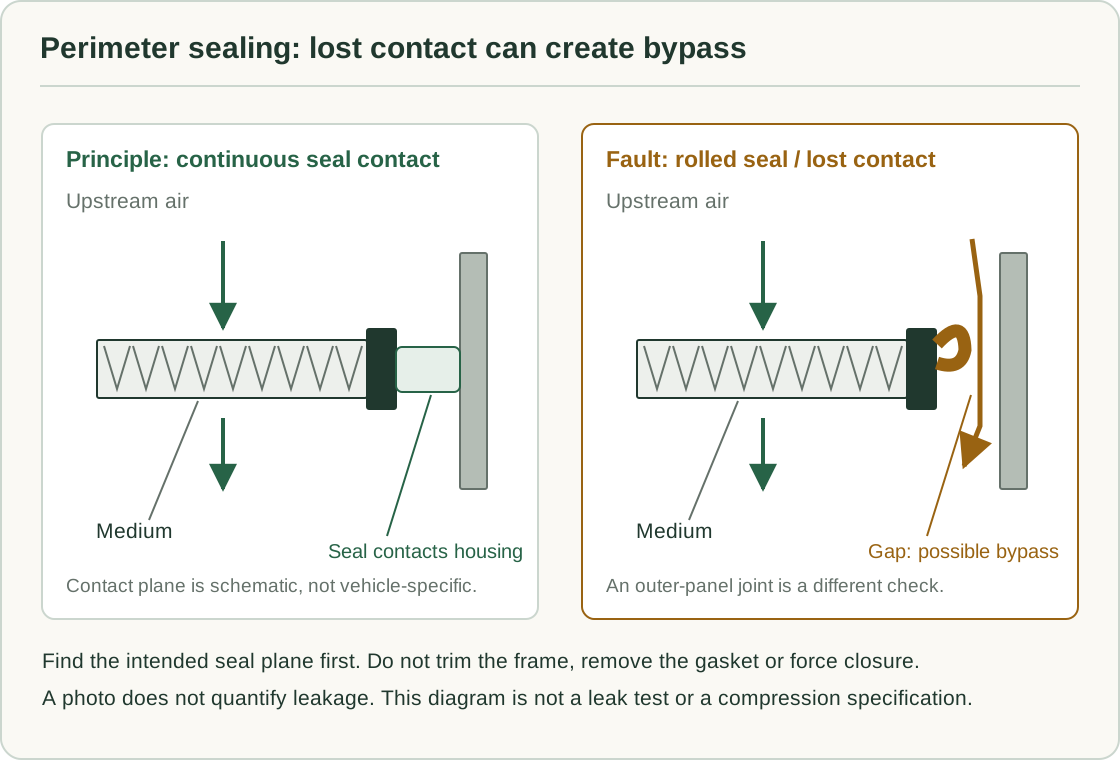
References: MANN-FILTER: quality comparison guide (PDF), MANN+HUMMEL: cabin filtration and system sealing
5. Decide what to correct, replace or escalate
An installation issue may be correctable using the specified procedure; an unconfirmed application or damaged part needs a different decision. Keep the supplied part unchanged while the supplier reviews the evidence. For a cracked housing, damaged latch or a suspected internal door problem, involve a qualified technician.
| Finding | Appropriate next step | Evidence to retain |
|---|---|---|
| Tray not seated or seal folded; no damage found | Refit only as instructed; confirm normal cover engagement before the final check. | Before/after photos and the instruction used. |
| Reference, geometry or tray requirement conflicts | Ask the supplier to confirm the exact application or provide the correct replacement. | Vehicle details, all references, measurements and drawing revision. |
| Frame, gasket, latch or housing is damaged | Stop forcing the assembly; arrange replacement or professional repair as appropriate. | Clear views of the damage and when it was first noticed. |
| Cause remains unclear | Mark fitment as unresolved; request a physical inspection or a documented sample review. | Unknown items, checks completed and the written response. |
6. For buyers: approve a defined sample, not just a catalogue label
Before approving a private-label sample, agree the reference, application evidence, drawing revision, construction and acceptance checks. Record the actual tray and seal arrangement in the sample review. If a reference has not been physically checked in the vehicle, state that limitation.
Keep dimensional conformance, installation fit and filtration performance as separate evidence. A sample that fits is not automatically proven to achieve a particle or gas-removal claim. Conversely, an excellent media report cannot correct an incompatible frame or seal.
Prepare a private-label sample and RFQ checklist · Download sample-review worksheets · Review particle, gas and HEPA evidence
Common questions
Can I trim the filter if its dimensions are nearly right?
Do not trim an unconfirmed replacement to obtain a fit. Ask for the correct application and approved construction. Removing frame or gasket material changes the fit and sealing arrangement.
Does every visible gap mean unfiltered air is leaking?
No. Identify the intended sealing plane. An outer-panel joint may differ from the filter perimeter seal. A visual inspection documents fit; a quantified leakage claim needs an appropriate test.
The catalogue lists my car. Why should I check the tray?
Application details and carrier arrangements can vary. Confirm the exact reference and the instructed tray or adapter. Similar overall dimensions do not establish identical locating or sealing features.
Sources & further reading
Check the current vehicle manual and the instructions supplied with the exact replacement filter. General guidance does not confirm a vehicle application.
For your next step
Comparing a specific filter? Keep the reference number, vehicle application and construction together when reviewing your options.