Freudenberg Filtura puts PET pleat stability and ePTFE cleaning performance in focus
A November 4 announcement ahead of FSA 2026 reports lower cleaning-air consumption in one customer comparison. The useful engineering question is how support stiffness, surface filtration and cleaning controls work together.
Event / announcement date ·
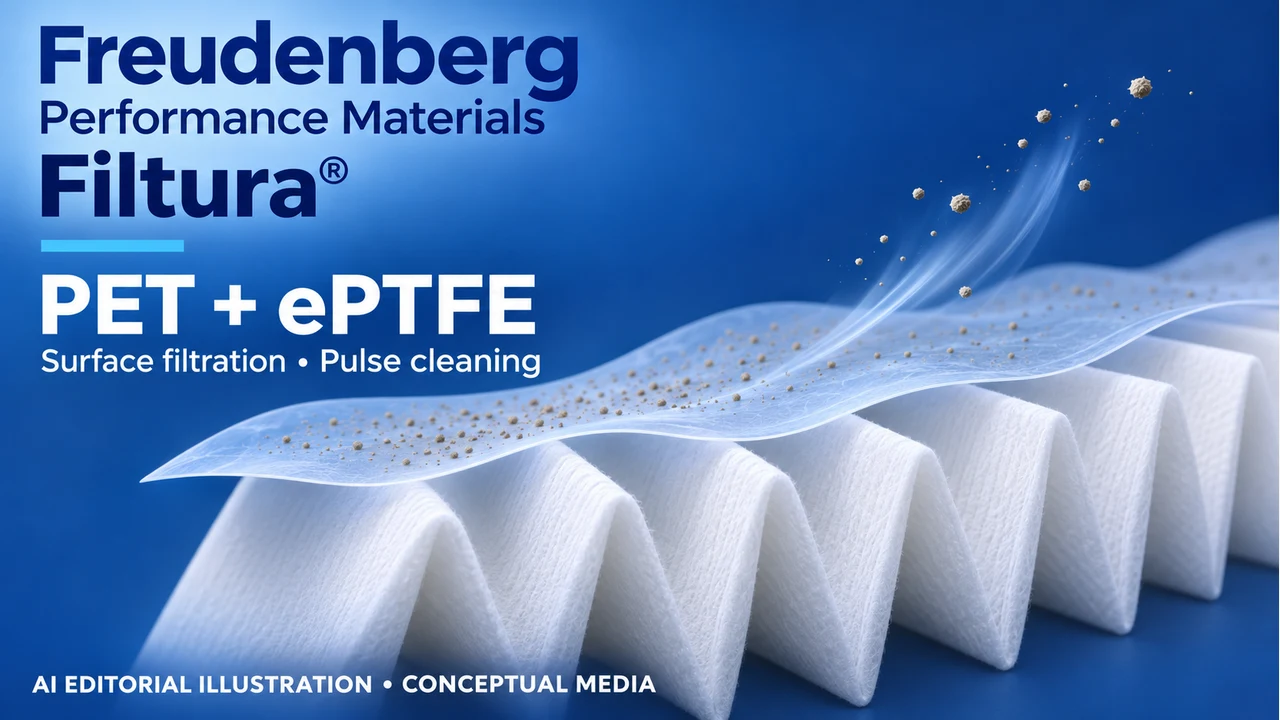
A November announcement ahead of the exhibition
Freudenberg Performance Materials announced on November 4 that it would present pleatable PET-based Filtura media at FSA in Shanghai, scheduled for November 18–20. The stated applications include metal processing, lithium-ion battery-material production and recycling, and metal additive manufacturing. The exhibition has not yet taken place at this article’s publication date.
The announcement describes a metal-processing customer switching from cellulose-blend media to PET media with an ePTFE membrane. Freudenberg reports approximately 20% lower compressed-air consumption and cartridge life extended by up to three months. These are manufacturer-reported customer results; the release does not provide the operating dataset needed to reproduce the comparison.
Why the PET support matters before adding a membrane
Pleating packs a larger filtering surface into a cartridge, but the useful area depends on maintaining its geometry. Freudenberg’s separate technology description identifies stiffness, dimensional stability and strength in both material directions as features of its spunbond portfolio. It also describes these materials as supports for laminated filtration layers.
Our engineering interpretation is that a fine separation layer and a mechanically stable carrier solve different problems. A membrane determines how particles encounter the surface; the support must preserve the element’s shape through handling and cleaning. A procurement specification therefore needs both filtration data and evidence that the finished pleated construction remains usable after repeated loading and regeneration.
Surface filtration changes where dust accumulates
Expanded polytetrafluoroethylene, or ePTFE, is used as a membrane layer on a supporting fabric. In its industrial-filter guidance, Gore contrasts dust accumulating at a membrane surface with dust entering a non-membrane medium. Keeping more deposit near the upstream surface can make that deposit easier to detach during cleaning.
This explains the attraction of the laminate, but it does not establish a universal efficiency or lifetime. Donaldson’s technical guidance notes that usable filtration velocity depends on the dust and collector housing. More folded area alone does not permit an equivalent multiplication of airflow. The relevant comparison is the loaded element operating at the required extraction flow, including its resistance after cleaning.
Fewer cleaning pulses are only one part of the energy balance
Parker’s instructions for its own ePTFE filter bags recommend extending pulse intervals only while the designed differential pressure is maintained. They also warn that excessive pulsing shortens bag life and describe demand-based cleaning. This is useful background, not a set of operating values to copy to a Filtura cartridge installation.
Compressed air and the extraction fan must be assessed separately. Donaldson explains that lower filter resistance can allow a fan to move more air; electricity savings are not automatic unless the operating point is adjusted appropriately. HDASHER’s assessment is therefore to measure cleaning-air use, actual airflow, pressure history and electrical consumption together. A reduction in one resource should not be relabelled as the same percentage reduction in total system energy.
What a credible application trial would establish
For a new dust stream, our proposed trial begins with its composition, particle-size distribution, loading, moisture and temperature. Fine metal dust, battery-processing dust and metal-printing powder are application descriptions, not interchangeable test aerosols. Selection also needs a process-specific assessment of fire and electrostatic hazards; a material feature alone does not certify a complete installation.
Compare old and proposed cartridges under matched production conditions, recording emissions, airflow, cleaning settings and replacement criteria. This would reveal whether an improvement comes from the media, a control change or different loading. The present announcement supports an industrial filtration case study; it supplies no basis for claiming the same saving, service interval or suitability for passenger-car cabin filters.