Apec adds six air filters for hybrid battery cooling
Analysis updated ·
Apec’s October range announcement includes filters for the cooling-air path of selected hybrids. Buyers need to distinguish this application from cabin and engine filtration.
Event / announcement ·
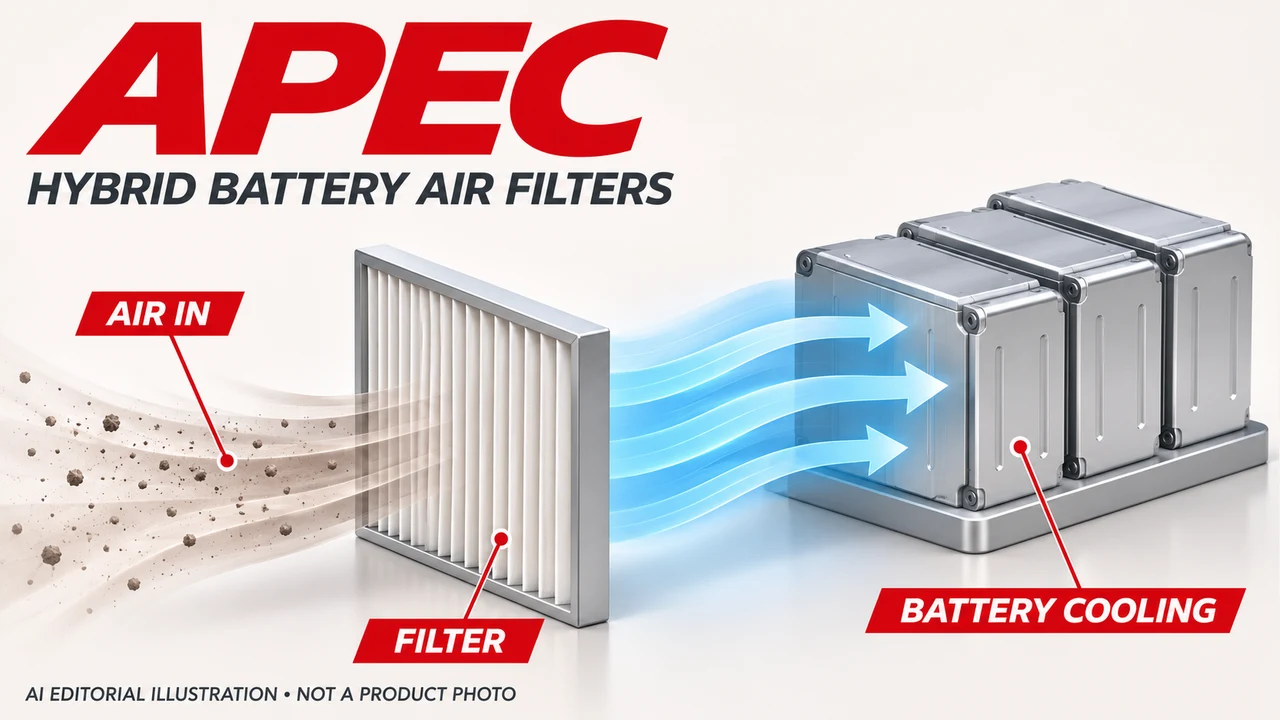
Six battery-cooling references within a wider service range
Apec’s October 22, 2026 announcement includes six air filters for battery cooling in selected hybrid applications, including Toyota models. The release does not list the six part numbers or their complete model-year coverage. The relevant development is an additional service category: a hybrid can have a battery cooling intake that needs attention separately from its cabin and engine filters.
Three air paths, three different jobs
An air-cooled traction battery requires a path for heat to leave the pack. HELLA’s thermal-management overview describes designs that draw cabin air across battery surfaces, alongside liquid- and refrigerant-based alternatives. The existence of those alternatives matters: the word “hybrid” alone does not establish that a vehicle uses an accessible battery-air filter.
For a workshop, the first question is therefore which air path the part serves. Replacing a cabin filter does not automatically service a battery intake elsewhere in the vehicle. Conversely, finding a small filter near a rear seat does not make it an interior comfort filter. The table describes functions rather than a universal vehicle layout.
| Air path | Primary purpose | What an apparently similar part does not prove |
|---|---|---|
| Engine intake | Provide filtered combustion air | Battery-cooling suitability |
| Cabin ventilation | Filter air supplied through the HVAC system | That a separate battery intake has been serviced |
| Battery cooling, where fitted | Limit debris entering the cooling-air path | Suitability for every hybrid or electric vehicle |
The engineering tradeoff is protection with enough cooling air
For a given cooling duty, air must carry heat away from the pack; the filter, duct and blower form one airflow system. Adding resistance can reduce the air delivered under a given operating condition. A visually denser material is consequently not proof of better battery protection. Dust capture must be considered together with resistance, loading behaviour and the prescribed installation.
This is engineering context, not a measured result for Apec’s six references. The release supplies no comparative airflow curve, temperature reduction or battery-life test. Applying a HEPA label or adding a carbon layer would not by itself demonstrate suitability for this task. Any such design change would need evaluation against the intended cooling system, rather than assumptions imported from cabin-air marketing.
A blocked intake can matter even when the filter looks ordinary
Toyota owner-manual guidance for vehicles with this arrangement warns that obstructing the battery intake can lead to overheating or reduced battery output. It also distinguishes removing dust at the intake from dealing with a filter that remains dirty. This is evidence that the air path is a real maintenance item, not evidence that every Toyota hybrid uses the same filter or interval.
Use the exact vehicle’s handbook for inspection and cleaning. The verified Toyota guidance keeps water and foreign material out of the intake; it should not be converted into a universal washing or compressed-air procedure. Inspection of a serviceable intake is also different from opening a high-voltage battery enclosure. Persistent warnings require the prescribed diagnosis, not repeated speculative filter swaps.
What would make a lower-priced alternative genuinely comparable?
A meaningful sample comparison starts with vehicle and OE identification, then records the installed fit, perimeter contact and condition of the retaining features. A laboratory comparison would additionally need the relevant airflow and dust-loading conditions. Photographs can document shape and damage, but cannot establish pressure drop or how performance changes after loading.
HDASHER’s assessment is that this launch broadens the parts conversation for hybrid servicing. For a buyer, that makes complete application data more valuable than a generic “hybrid filter” description. Price should be compared after the same fitment and duty are established; the announcement does not prove lower lifetime cost, a particular replacement interval or superiority over the OE part.